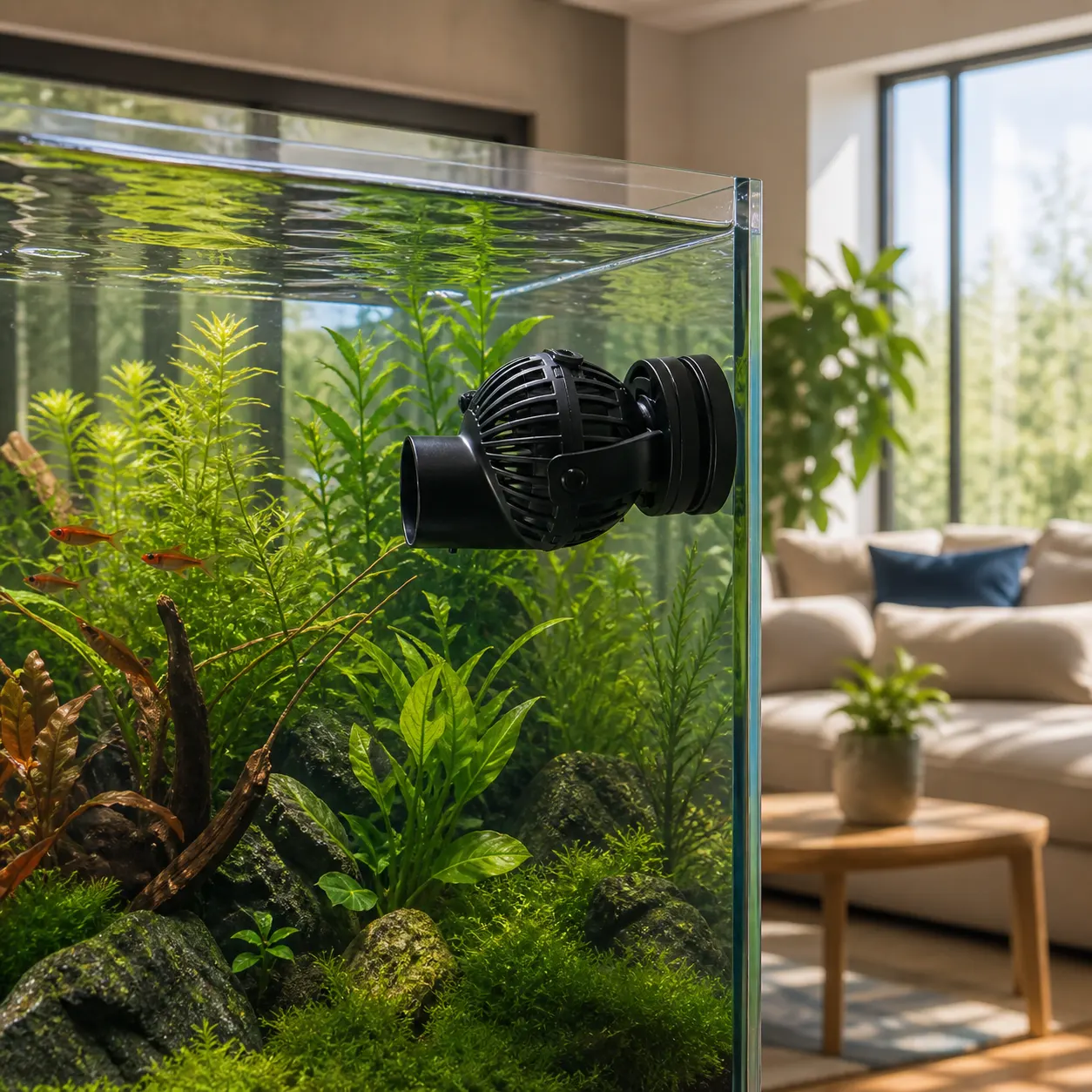
Short answer: An aquarium wave maker for a small tank should be chosen only after confirming that the tank needs targeted circulation and that the output can be adjusted without dominating the available swimming space. The Hyggeraqua listing identifies a Jebao CWP-6000L/H manual variable-frequency wave maker and states that the selected SKU is for aquariums below 0.6 m. It does not specify flow rate, tank volume, dimensions, power, mounting or livestock suitability. Tank length alone is therefore not approval: plan placement, preserve calmer areas and verify the manual and electrical details before purchase or installation.
Interpret the below-0.6 m listing correctly
The selected SKU's published size statement refers to aquariums below 0.6 m. The page does not state whether that means internal or external length, and it does not provide a litres range. Two tanks with the same length can have different volume, layout, livestock and flow needs.
Use the statement as an initial relevance check only. Confirm the exact tank dimensions, open swimming area and existing filter movement before treating the model as a candidate.
| Buying question | Published answer | Evidence gap |
|---|---|---|
| Which model? | Jebao CWP-6000L/H | Exact package and manual |
| Which tank size? | Selected SKU listed below 0.6 m | Tank volume and interpretation of length |
| Can output be adjusted? | Manual variable-frequency configuration | Flow rate and setting curve |
| Is it electrically suitable? | Manufacturer does not specify on page | Voltage, wattage, IP rating and cable details |
Test the need before adding equipment
A wave maker is most defensible when the filter operates normally but one defined area remains sheltered. Check and maintain the filter according to its instructions, then observe where particles and surface movement travel.
Do not add circulation to compensate for an unresolved filter fault or poor maintenance. The product is categorised as a wave maker, not a filter.
- Observe the aquarium after normal maintenance and identify any repeated low-flow pocket.
- Check whether the existing filter outlet can be redirected without compromising its intended operation.
- Map a pump position that leaves open swimming and calmer areas.
- Confirm the CWP-6000L/H manual, electrical data and mounting before installation.
- Start with minimal disruption, observe the aquarium and remove the unit if suitable conditions cannot be maintained.
Use welfare observations, not a generic setting
RSPCA guidance places fish welfare and a suitable environment at the centre of aquarium care. The product page provides no species-specific flow advice, so there is no evidence-based universal setting for a small community tank.
Observe whether fish can feed, rest and use the tank normally, and whether plants or substrate remain stable. Seek species-appropriate advice where the response is uncertain.
Safety and missing specifications
The manufacturer does not specify flow rate, wattage, voltage, dimensions, cable length, IP rating, mounting strength, noise, tank volume, service life or species suitability on the page. These are evidence gaps to resolve, not values to infer from the model number.
Follow HSE electrical principles: use suitable maintained equipment, keep connections dry and isolate power before touching or repositioning in-tank equipment. Do not use a damaged cable or an undocumented adaptor.
Related guides and product details
Choose this wave maker for a small tank only when the below-0.6 m listing, confirmed technical details and a cautious placement plan all match the aquarium. Read Fish Tank Dead Spot Pump: Detritus Troubleshooting for related guidance. Read Aquarium Circulation Pump for a Planted Tank for related guidance. Review the documented specification on the Jebao CWP-6000L/H Aquarium Wave Maker Pump product page before ordering.
Sources and safety context
- Supports the model, manual variable-frequency control, below-0.6 m statement, category and plastic material. Current Hyggeraqua wave maker product page.
- Supports use of suitable maintained equipment and control of electrical risks. Electrical safety at work.
- Supports prioritising a suitable maintained environment and fish welfare. Keeping fish as pets.